
- Forms & Publications
- FAQ
All
Prevailing setbacks apply to areas with developed lots (where some homes burned down, and with some homes still standing) of varying front yard setbacks. See Information Bulletin P/ZC 2023-015 on how to calculate prevailing setbacks.
For blocks on the same side of a street where there are no developed lots (homes completely burned down), prevailing setback does not apply and the front yard shall be per the zoning code according to the lot's zone.
For blocks on the same side of a street where some homes were damaged or destroyed and others were not, prevailing setback standards will apply.
Was this helpful?
LADBS would use available records to establish what was on a site prior to the wildfire. New building plans would then need to be prepared and submitted to the Department for review. See Plan Submittal Checklist.
Was this helpful?
If the foundation was removed, LADBS would use available records to establish where the footprint of the foundation was originally. Please see question above regarding what records LADBS will use to establish what was on a site prior to the wildfire.
Was this helpful?
A slope band analysis is not required if rebuilding as a like-for-like +10% project. Otherwise, projects within a designated hillside area will require a slope band analysis.
Was this helpful?
Under the Governor's Executive Order N-29-25 issued on July 7, 2025, solar pv systems are not required.
Was this helpful?
A project may be rebuilt with the same nonconforming use, yards, height, number of stories, lot area, foot print, floor area, residential floor area, residential density, or parking as the structure that existed or had a valid permit immediately before the Wildfire. Provisions in LAMC 12.23 may be used as applicable.
The new structure cannot exceed 110% of the footprint or height of the existing structure immediately before the Wildfire. Any part of the repaired or replacement structure that extends beyond the existing building footprint must comply with the required yards and setbacks according to current LAMC.
Acceptable records shall include building permits, Certificate of Occupancy, County Assessor, and Coastal Commission, whichever is larger. On a case by case basis, the Department may consider other photographic sources such as Google Maps and LiDAR.
A "like-for-like" project must be in substantially the same location as the structure(s) that existed or had a valid permit immediately before the fire. Please see below regarding "substantially same location".
Was this helpful?
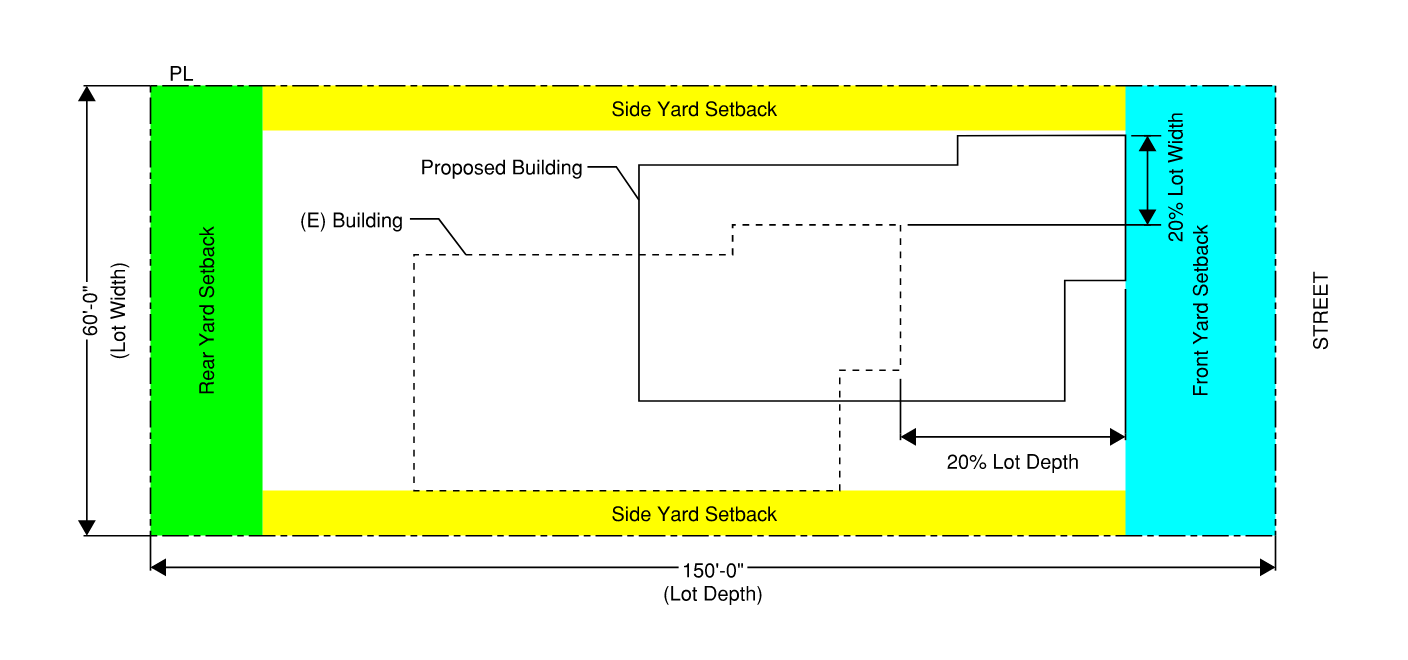
The proposed building shall be located within a maximum offset of the existing building footprint. The allowable offset shall be a maximum of 20% of the lot width and 20% of the lot depth, in the same direction as the lot width or depth, respectively. The proposed building shall comply with all applicable yard setback requirements. However, for a building that was damaged or destroyed by the Wildfire and had a nonconforming yard, the new structure may be rebuilt or relocated within the nonconforming yard, provided the nonconforming yard is not further reduced.
Was this helpful?
Acceptable records shall include building permits, Certificate of Occupancy, County Assessor, and Coastal Commission. On a case by case basis, the Department may consider other photographic sources such as Google Maps and LiDAR.
Was this helpful?
Under the Mayor’s Emergency Executive Order #1, DBS and other City departments will complete their initial reviews for building permits within 30 days. However, DBS has so far been able to complete the review within 10 days. Prior to permit issuance, other agency approval/clearances are required, as well as the customer addressing any plan check corrections, which may affect the timeline. Once all agency approval/clearances have been completed, DBS can issue the permit.
Was this helpful?
LADBS will expedite review of all rebuild projects.
Was this helpful?